
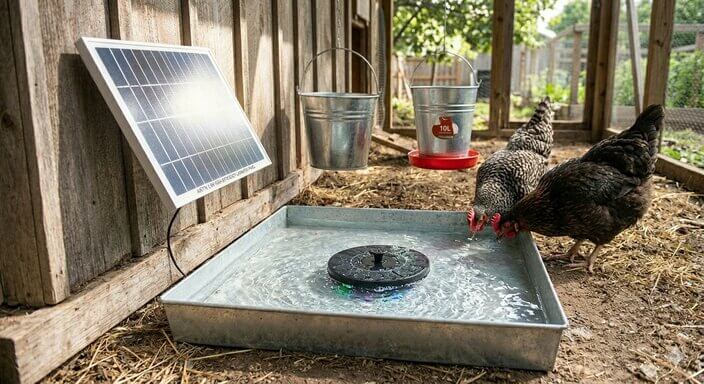
If you’ve ever walked into your coop on a sweltering July afternoon only to be met by the sour, stagnant smell of “swamp water,” you know the struggle. Keeping the girls hydrated is a full-time job, and for many of us, the coop is way too far from the house to justify dragging a hundred feet of extension cord through the mud. Solar power is the most practical solution for remote coops because it puts the sun to work exactly when the water is most at risk of spoiling. Using a solar powered floating aerator is the easiest way to bridge that gap without digging trenches for wires.
In my coop, I’ve found that the biggest hurdle isn’t the heat itself, but the lack of movement in the drinking tray. To get the best results, you need a unit that is actually built for the grit and dander of a working farm. For those looking for a durable, high-efficiency setup, I highly suggest checking out my hands-on testing of the ALUKIKI 4W Solar Fountain. It’s one of the few units I’ve found that uses an upgraded glass panel to stand up to the elements without clouding over.
Do Solar-Powered Fountains Really Work?
The Off-Grid Advantage
Switching to solar for your water aeration isn’t just about saving a few bucks on the electric bill; it’s about safety and reliability.
- Zero Fire Risk: I’ve seen too many horror stories of extension cords shorting out in dry straw. Solar is low-voltage and stays safely contained at the coop.
- Automatic Peace of Mind: The system turns itself on the second the sun hits the panel, meaning you don’t have to remember to flip a switch when the temperature spikes.
- Total Independence: Whether you have a suburban lot or forty acres, you don’t need a professional electrician to provide fresh, moving water to your flock.
Signs Your Water Needs Better Aeration
Don’t wait until the girls are thirsty to check your setup. Keep an eye out for these specific “red flags” in your run:
- Slime Build-up: Run your finger along the inside of the tray. If it feels slippery, algae is already winning.
- Lethargic Hens: If the girls are panting and avoiding the waterer, it’s likely because the water is too warm or tastes “off.”
- Mosquito Larvae: If you see anything moving in that water that isn’t a chicken’s beak, you have a stagnation problem.
- The “Duster” Effect: If your water is covered in a thick layer of dander and feathers, the lack of surface movement is letting bacteria breed.
The 3-Step Homestead Setup Plan
You can have a solar aeration system running in less time than it takes to collect the morning eggs. Here is my DIY-friendly plan:
- Select a Heavy Basin: Use a shallow, galvanized or BPA-free plastic tray that is heavy enough that the girls won’t flip it when they hop on the edge.
- Lock the Position: Use “anti-drift” arms or fixers to keep your fountain centered. This prevents water from spraying out onto your dry bedding.
- Find the “Sweet Spot”: Mount your solar panel where it will catch the 12:00 PM to 4:00 PM sun—this is when the water is most likely to turn stagnant and needs the most movement.
Solar Maintenance (Pro Advice)
Solar gear is tough, but it isn’t “set and forget.” Follow these three habits to keep things humming:
- The Saturday Wipe-Down: Chickens are dusty creatures. A thin layer of dander can drop your panel’s efficiency by 30% or more. Wipe it with a damp rag weekly.
- Check the Intake: Every few days, pull the pump and check for small feathers or straw that might be clogging the filter cotton.
- Cable Inspection: Always tuck your wires behind a post or inside a piece of PVC pipe. Bored hens can’t resist a “snappy” looking cord.
FAQs
Does it work when the sun goes down?
Most standard solar fountains stop when the sun sets. However, the goal for algae prevention is to move the water while it’s being heated by the sun. If you need night-time movement, look for a model with a built-in battery.
Will the spray scare my chickens?
Most girls are curious. I recommend skipping the “high-spray” nozzles and just using the bare pump to create a gentle “bubbling” effect. It’s quieter and doesn’t splash the bedding.
What happens if the tray runs dry?
Look for a unit with “water-shortage protection.” This ensures the pump shuts off automatically if the girls splash the tray empty, saving the motor from burning out.
Conclusion
Solar power has truly simplified my daily chores, and my girls were much happier once I stopped giving them “bath water” to drink. It’s an honest, effective way to use the very thing that causes algae—the sun—to fight it.
Expert Tip: If you’re dealing with a deep-freeze winter, pull your pump out once the water starts to skin over with ice. Aerators aren’t de-icers, and trying to spin against ice is the fastest way to kill a good motor!
